
Captive portal login explained for partners
Captive portal login, explained for partners: authentication flow, security and privacy limits, failure fixes, and when to drop the splash page.
What a network access controller does, how it enforces policy, deployment models, integrations, ROI metrics and vendor criteria for UK IT teams.
A network access controller is the policy engine that decides whether a user, device or session may connect to the network, and what it may reach once connected.
Knowing the WiFi password shouldn't give a visitor's laptop the same access as a managed finance workstation. Yet that's the practical outcome when an organisation relies on shared credentials and a flat network. For UK MSPs and IT managers, network access control (NAC) turns that broad permission into a decision based on identity, device condition and business need.
The buying challenge isn't finding a platform with enough features. It's knowing which components make the decision, which equipment enforces it, and what happens when something fails.
A contractor's visitor badge gets them past reception. It does not open the server room. A network access controller draws the same line for connectivity: it identifies who or what is joining, then grants only the access that identity and device justify.
Endpoint malware protection is common on managed PCs. It still answers a different question from whether an unfamiliar laptop should sit on the internal network. Software on the device does not set that device's starting permissions.
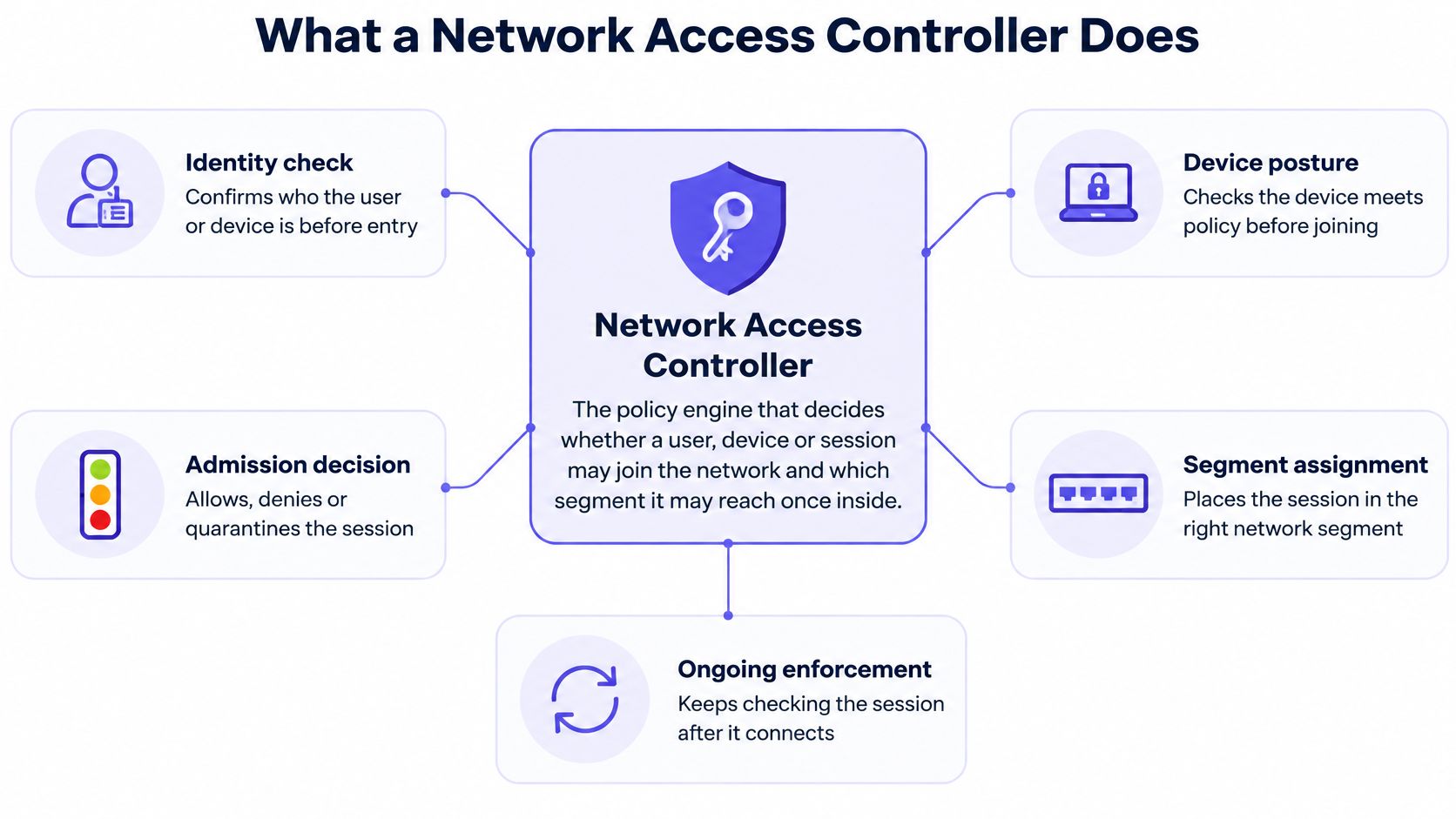
A firewall filters traffic between zones or systems. The controller sets the connecting device's starting permissions, and the firewall can then limit what traffic is allowed from that position. You still need both.
A VPN supplies an encrypted tunnel for remote connectivity. The tunnel does not, by itself, show that the device is healthy or that the user needs broad internal access. NAC commonly handles admission on office WiFi and wired ports. It can also work with remote-access systems when those systems pass identity and session context through.
For the contractor, a shared WiFi password only proves they hold a secret. An identity-based policy can recognise their account, tell an unmanaged laptop from an enrolled workstation, and give internet-only access.
That record matters when someone says they are on the WiFi. A connected icon does not mean the endpoint can reach business systems. The controller may have placed it on a restricted segment on purpose.
A network access controller isn't necessarily a box through which every packet travels. It's usually a collection of decision software, identity integrations and network enforcement points. Label these components in your own estate before comparing suppliers.
Core components of a network access controller
| Component | Role in the access decision | Typical technology |
|---|---|---|
| Policy decision point | Evaluates identity, device posture and context, then admits, quarantines or denies | NAC software or appliance policy engine |
| Enforcement point | Applies the decision at the port or SSID through 802.1X, VLAN assignment or ACLs | Access switches, wireless controllers, cloud-managed APs |
| Identity source | Confirms who the user is and which groups they belong to | Active Directory, Entra ID, Okta, Google Workspace |
| Posture and compliance source | Confirms the device is healthy and trusted before sensitive access | MDM, EDR, device certificates |
| Onboarding module | Provisions BYOD devices and walks guests or sponsors through approval | Self-service portal, sponsored guest workflows |
| Profiling and discovery | Fingerprints device types, including IoT without users | DHCP fingerprinting, RADIUS attributes, behavioural baselines |
| Segmentation engine | Maps admitted devices to the least-privileged segment | VLANs, security groups, network ACLs, policy connectors |
| Logging and reporting | Records every decision for audit and anomaly hunting | Syslog, SIEM integration, dashboards |
The policy decision point needs reliable evidence. Directory membership establishes a person's role; mobile device management (MDM) reports enrolment and compliance; endpoint detection and response (EDR) can contribute risk information. A certificate establishes possession of a credential, not proof that every security requirement has been met.
The enforcement equipment must also understand the result. A correctly calculated role achieves nothing if an access switch ignores its VLAN assignment or an upstream firewall permits unrestricted inter-segment traffic. GOV.UK guidance on network infrastructure in shared buildings provides a useful design reference for admission and network separation.
Onboarding is the controlled route from an unknown device to an approved credential or guest session. It must be reachable without accidentally exposing internal resources. Keep certificate enrolment, recovery and device replacement in scope when securing WiFi access.
Segmentation defines what happens after admission. Give printers access to the services they require, not finance workstations; give CCTV equipment access to its recording and management systems. Test those boundaries with actual connection attempts, rather than assuming a VLAN name proves isolation.
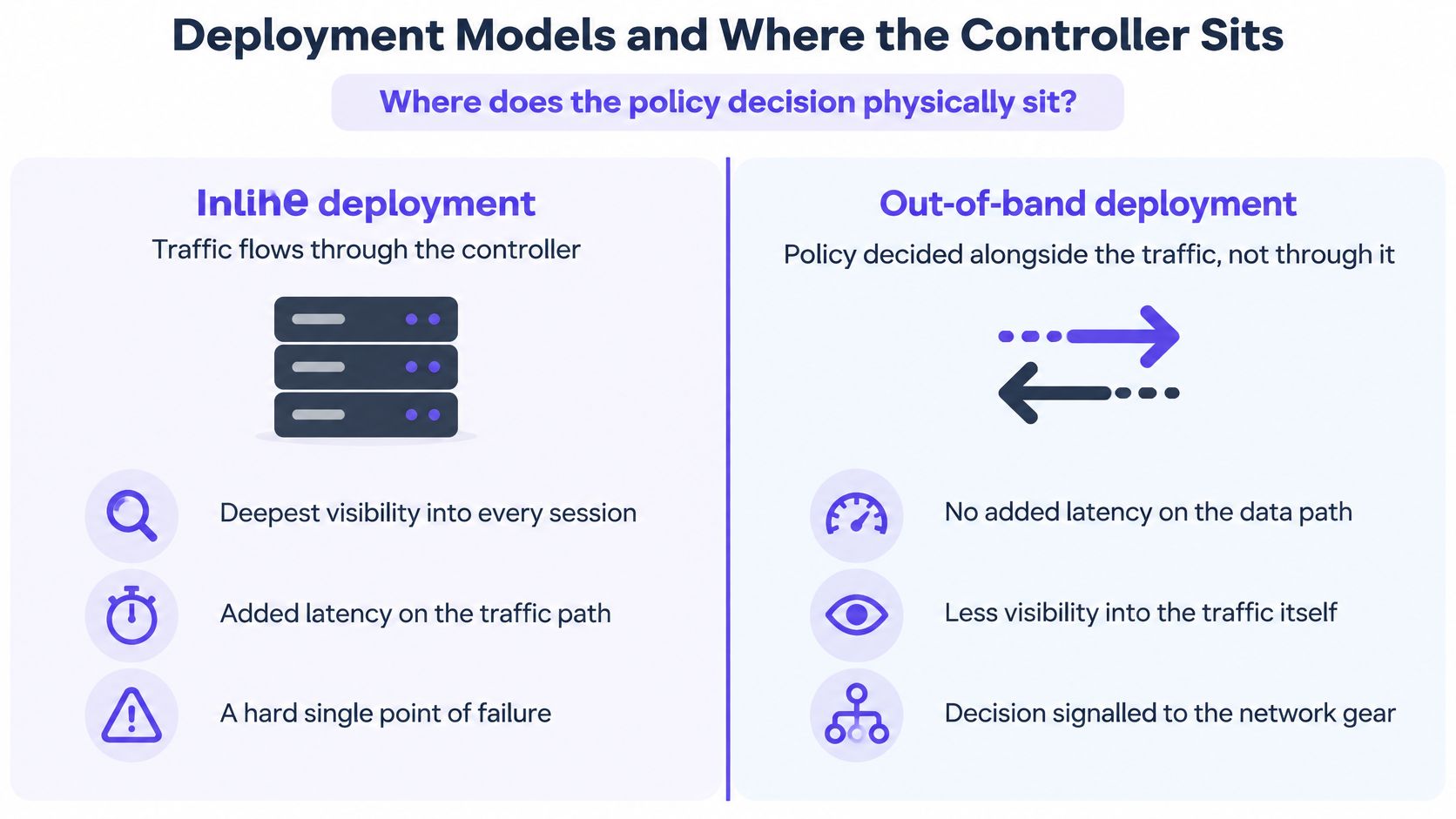
Ask where the policy decision, enforcement and user traffic sit. They don't have to occupy the same location. A cloud-managed service can make decisions remotely while a local switch applies restrictions and forwards traffic.
NAC deployment models compared
| Model | How it enforces policy | Strengths | Watch-outs | Best fit |
|---|---|---|---|---|
| Inline | Traffic traverses the controller on the protected path | Deep per-session visibility and control | Adds processing and a failure point; capacity planning is critical | Small sites needing granular inspection |
| Out-of-band | Controller instructs switches and APs via RADIUS and Change of Authorisation | Scales without a user-traffic bottleneck | Enforcement relies on equipment support and configuration; traffic inspection is separate | Enterprise campuses and branch estates |
| Cloud overlay | Cloud policy service directs enforcement at the AP or switch | Central management and rollout across compatible existing hardware | Policy-service reachability and equipment compatibility need validation | Distributed estates and multi-site MSP clients |
| Hybrid | Cloud policy plane with local enforcement and supported cached policies | Combines central control with local resilience | More components and cache-expiry behaviour to test | Organisations migrating from appliance-based NAC |
Inline deployment makes the controller part of the forwarding path. That can support granular inspection, but throughput, maintenance bypass and high availability become production-network concerns. Don't assume an inline appliance inspects encrypted application content merely because packets traverse it.
With out-of-band deployment, the controller handles authentication and authorisation alongside the traffic path. RADIUS carries authentication and policy information, while Change of Authorisation (CoA) can request an updated session policy or disconnection. Access equipment still needs the right configuration and supported capabilities.
A cloud overlay changes the location of management and decision services, not necessarily the forwarding path. Hardware-agnostic doesn't mean every access point supports every enforcement feature. Hybrid designs can retain local authentication or cached decisions, but only where the selected architecture explicitly supports them.
Fail-open permits some access when the policy service is unavailable. Fail-closed denies access to protected resources, potentially offering only a designated restricted service. Existing authenticated sessions and new connection attempts may behave differently.
Practical rule: Test a policy-service outage with an already connected device, a returning device and a completely unknown device. Record each result separately.
Also test expired cache entries, certificate validation failures and recovery after service returns. A system that reconnects technically but leaves sessions in the wrong role hasn't recovered correctly.
Use inline as a starting candidate for compact sites requiring traffic-path control, out-of-band for campuses, and cloud overlays for distributed estates. Treat those as shortlist rules, not substitutes for compatibility and resilience testing.
An integration logo on a product page doesn't establish what information the controller receives or how quickly it acts. Build the integration checklist around questions the access policy must answer.
Active Directory, Entra ID, Okta and Google Workspace can supply identities and group membership. Decide which system is authoritative, how nested groups are handled, and what happens when someone changes role.
SAML and OpenID Connect commonly support browser-based sign-on. SCIM can support account provisioning and lifecycle synchronisation where implemented. Neither replaces the endpoint authentication exchange at a wired port or enterprise WiFi connection.
MDM and EDR integrations can report enrolment, encryption, operating-system compliance and compromise indicators. Specify how old a result may be before it is no longer acceptable. An unavailable posture service must not become a clean bill of health.
A public key infrastructure (PKI) supplies device certificates, renewal and revocation services. Protect private keys with hardware-backed storage where supported, and configure endpoints to validate the authentication server's certificate. The certificate-based WiFi via MDM guide is useful when planning the enrolment workflow.
The NCSC's enterprise-authentication recommendations favour strong user and device authentication, reduced password reliance and hardware-protected device credentials. Those principles make certificate ownership and lifecycle management architectural decisions, not background administration.
Check 802.1X, EAP-TLS, RADIUS and CoA against the exact switch and wireless firmware in service. Demonstrate dynamic placement, a policy change during an active session, and disconnection of a revoked device. A successful initial login tests only part of the integration.
For operations, export policy outcomes to a security information and event management (SIEM) platform. Include timestamps, policy identifiers, enforcement equipment and reasons for rejection, while limiting personal data to what's necessary. DHCP fingerprints and RADIUS attributes can help classify browserless equipment, but classification shouldn't be mistaken for strong authentication.
For each connector, test both rejection and unavailability. A clean denial is operationally different from a timeout, and the service desk needs to recognise the difference.
The useful policy isn't “allow employees”. It describes how a particular person and device should behave in a particular environment. These scenarios translate that principle into deployable rules.
Say an office gives everyone the same wireless password. A departing employee still knows it, and administrators can't distinguish their personal tablet from a managed laptop from possession of that password alone.
Replace that arrangement with certificate-based access provisioned through the organisation's identity and device-management workflow. A joiner receives the appropriate configuration after enrolment; an account suspension triggers the defined credential and session-revocation process. An unmanaged laptop receives restricted onboarding access rather than the staff role.
The policy sketch should specify eligible identity groups, accepted certificate issuers, required compliance state and permitted destinations. Include device replacement and lost-device recovery, because a secure design that staff can't recover from will generate pressure for bypasses.
At a reception-led office, visitors might previously have received a printed password and little explanation of its scope. A controlled guest workflow lets them self-register or obtain sponsor approval, then receive an internet-only session with an explicit expiry.
Apply bandwidth controls where the venue needs them, and keep administrative systems out of reach. A captive portal is an onboarding interface, not the isolation mechanism itself. The underlying access equipment and routing policy must enforce the guest boundary.
Collect only information needed for the stated purpose. Keep optional marketing choices distinct from the connection process, explain retention, and ensure reception staff can help a visitor without granting broader permissions.
Consider student accommodation where residents need phones, laptops, games consoles and smart TVs to work together. A building-wide guest network can frustrate that experience, while an unsegmented resident network exposes neighbours' devices to one another.
Assign each tenancy a private network context, with controlled access for residents and their guests. Browserless devices need an onboarding method they can use, such as a tenancy-bound network pass. Design local discovery deliberately so a resident can reach their own television without discovering equipment in another unit.
The policy sketch needs tenancy creation and expiry, guest permission handling, device removal and separation from building operations. Keep CCTV, door-entry systems and property-management equipment outside resident access.
The NCSC's ZTNA implementation guidance supports explicit access decisions and controlled segment access. At the shared-building edge, apply that discipline to Ethernet ports as well as WiFi.
A lobby wall socket shouldn't become an easier route into the business than the wireless network.
Buying decisions become expensive when a useful capability is presented as a complete security architecture. Ask suppliers to demonstrate the specific control they claim, including the enforcement location and failure behaviour.
NAC delivers zero trust. A controller can support identity-aware admission and segmentation, but purchasing it doesn't automatically provide application-level authorisation, secure transport or continuous evaluation of every service request. The NCSC's zero-trust architecture principles require explicit authorisation using relevant identity and device signals, rather than treating internal network connectivity as permission.
MAC authentication proves identity. A MAC address is spoofable; it isn't a cryptographic credential. Reserve this method for equipment that can't use stronger authentication, and constrain it with device-specific permissions, location checks where practical, and alerts for unexpected changes.
NAC is a set-and-forget appliance. Administrators must maintain certificate renewal, directory mappings, endpoint compatibility and posture policy. Give exception rules an owner and review condition, otherwise temporary workarounds can become permanent routes around the intended policy.
Guest access is just a captive portal. A visitor-facing page doesn't establish whether guest traffic can reach internal systems, how long a session remains valid or what happens to collected information. Evaluate onboarding, enforcement and data handling as separate responsibilities.
When evaluating a zero-trust approach, ask where application requests are authorised and what causes an active session to lose access. If the demonstration stops at assigning a VLAN, the demonstrated capability is network admission and placement.
Ask who enforces encrypted transport, which services verify user identity independently, and whether risk changes reach those services. These questions don't diminish NAC's value. They prevent a buyer from leaving other controls unowned because a supplier used a broad label.
The boundary: NAC decides which network segment a device may enter. A zero-trust architecture decides whether each request to a service should succeed.
Keep that distinction in the statement of work. Assign ownership for admission, segment enforcement, service authorisation and recovery, with acceptance tests for each rather than a single promise of secure connectivity.
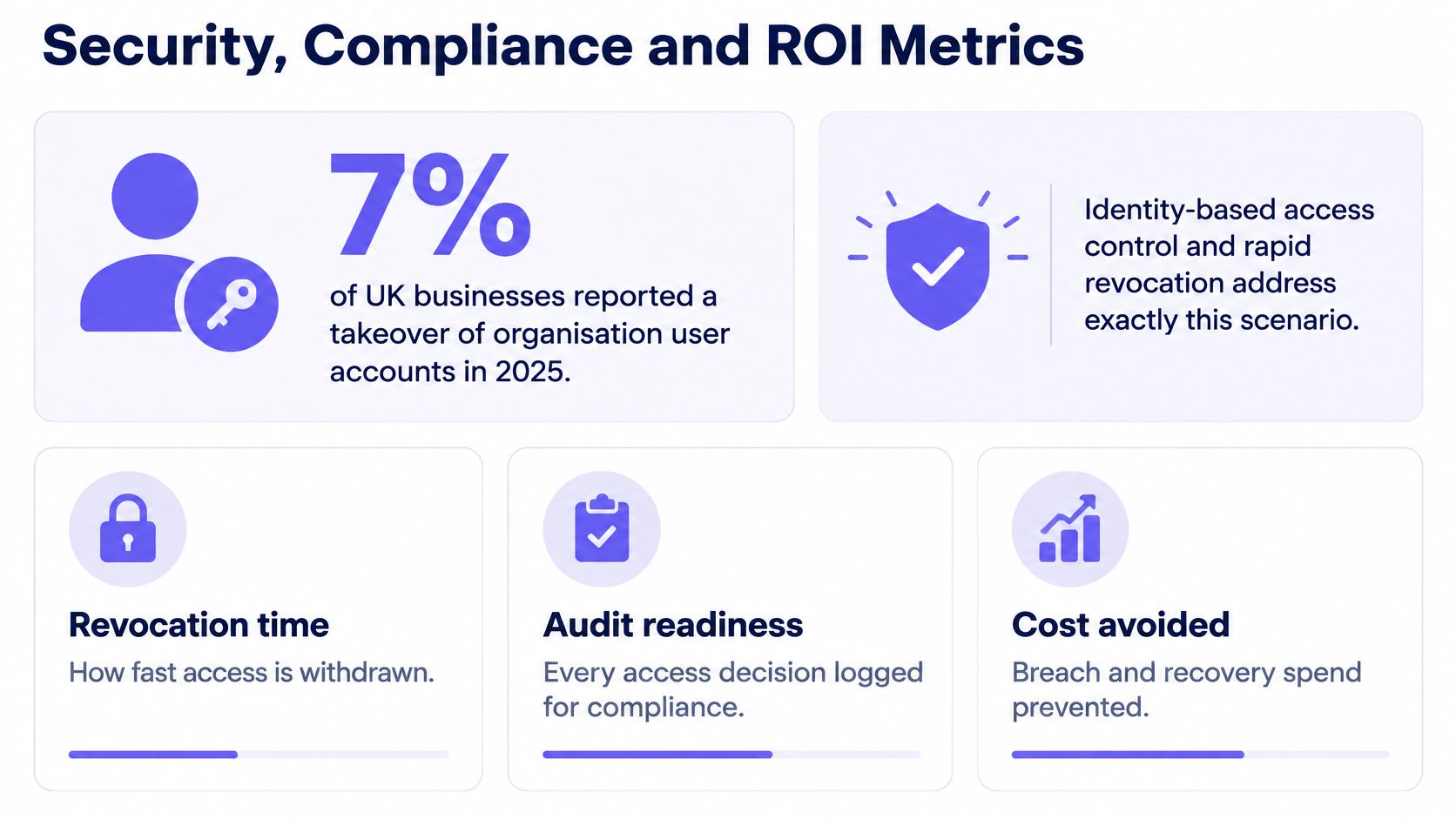
Account takeover is a common risk for organisations. Identity-based policy and rapid revocation address part of that risk. Disabling an account is not the same as ending every session already in progress. A changed door code stops the next person at the entrance. It does not walk someone who is already inside back out of the building. Measure both events, or the scorecard will look healthier than the network is.
Baseline results before deployment, then compare equivalent device groups and sites. A rising failure count may reflect newly visible legacy equipment rather than deteriorating service. That spike is often the first honest view of devices that previously connected with no check at all.
NAC metrics that demonstrate ROI
| Metric | What it tells you | Healthy signal |
|---|---|---|
| Authenticated device coverage | Share of endpoints admitted through 802.1X, certificates or a portal rather than open access | Trending towards all managed endpoints, with each exception documented |
| Mean time to revoke access | How quickly a leaver or compromised device loses connectivity | Meets the organisation's tested revocation objective, including active sessions |
| Posture pass rate | Share of devices meeting compliance policy on first check | Improving trend with a short quarantine queue |
| Guest onboarding completion time | How long a visitor needs from arrival to connected | Meets the venue's agreed service target without staff intervention |
| Authentication success rate | Share of connection attempts that succeed without manual intervention | Stable high rate, with sustained drops investigated |
| Quarantined policy violations | Volume and type of devices automatically restricted each month | Every item has an owner and a closed remediation action |
| Blast radius in incidents | Segments an attacker could reach from a compromised endpoint | Reduced reachable scope, confirmed through testing |
Define the start and stop event for each timing metric. For revocation, start with the authorised suspension action and stop when both an existing session and a new connection attempt can no longer reach protected resources. A directory disable that leaves a wireless session up until the next reauthentication has not finished the job.
Track helpdesk tickets per connection volume alongside security outcomes. Separate certificate errors, onboarding confusion and genuine policy violations so a headline success rate does not conceal an expensive support burden. One site with a high success rate and a long ticket queue is not the same result as a site that connects cleanly.
Exportable decisions, approved exceptions and tested segmentation can support control evidence for Cyber Essentials assessments and ISO 27001 audits where relevant. They do not make the organisation compliant on their own, and an access-control deployment does not establish whether a particular regulatory regime applies. Auditors still need to see who approved each exception and how long it stayed open.
Guest records also require deliberate privacy management. Record the purpose of collection, access permissions and retention rules. Do not retain identity information indefinitely because the controller can store it. A field the portal captured for a one-day visit should have a deletion date, not a permanent row in a marketing export.
For the board, separate measured savings from risk-reduction assumptions. Count reduced password administration, shorter onboarding support and less time assembling audit evidence using actual staff effort. Include licensing, integration maintenance, certificate operations and training in costs. A pilot that saves two helpdesk hours a week and adds a certificate renewal task every month has not yet paid for itself.
Do not book an avoided breach as a realised saving. Show the tested reduction in reachable systems and explain the financial assumptions separately.
That produces a defensible investment case without treating every blocked connection as an incident that would otherwise have happened.
Shortlist suppliers against the estate you operate, not a polished demonstration network. Existing access points, switches, identity systems and endpoint types should appear in the acceptance plan.
A credible roadmap should distinguish released capabilities from planned work. Don't make a critical acceptance requirement dependent on an undated future feature.
For MSPs and integrators, include training, certification, deal registration, white-labelling and support responsiveness. Establish who owns escalations when a problem spans access hardware, identity services and policy software.
Purple Partners is our channel programme for resellers, MSPs and systems integrators selling identity-based WiFi solutions. Our Staff WiFi works with Entra ID, Google and Okta; our hardware-agnostic cloud overlay deploys on a client's existing WiFi infrastructure, and in most cases no additional hardware is required.
Our partner portal provides enablement, deal registration, training and support without minimum revenue commitments, and the platform can be white-labelled. Validate deployment fit through the same pilot criteria you'd apply to any supplier: supported equipment, lifecycle handling, user recovery and operational evidence.
Treat hardware reuse as a proposition to prove on the customer's estate, not permission to skip compatibility testing.
Run a 30-day pilot as a defined evaluation window, not a promise that every estate can be migrated within that period. Assign a technical owner, a service-desk contact and someone authorised to stop the rollout.
Include normal working conditions. A pilot confined to IT staff with freshly enrolled laptops won't expose reception workflows, shift changes or older operational equipment.
Prefer certificates wherever endpoints support them. Give legacy devices narrowly defined exceptions, monitor unexpected connections, and include unused wired ports in the migration rather than treating wireless as the whole estate.
Start by selecting the pilot site and writing the acceptance tests. A successful result is a network whose access decisions you can explain, revoke, recover and operate, not merely a dashboard showing connected devices.
Purple offers identity-based Staff WiFi, Guest WiFi and private multi-tenant networking on existing compatible infrastructure. Visit Purple to discuss a pilot that tests your directory integration, onboarding journeys and access-revocation requirements before a wider rollout.
Join 80,000+ venues already running on Purple. No targets, no minimums, just bigger deals.